project
Palantir Foundry: Incident Triage Agent
June 2026
I built this to impress Palantir. Straight up. I had an interview coming and I wanted to walk in having already used their platform, not just talked about it. So I gave myself one session inside Foundry and built something real.
The result is a full incident triage agent, end to end. Three ontology object types backed by live datasets, an AIP chatbot that runs semantic search and actually reasons over document content, a governed write-back action gated behind human approval, and a published Workshop app. It runs the whole operational loop: take a natural-language query, find the incident, surface the matching runbook, locate the on-call engineer with the right expertise, apply the escalation rules pulled from the runbook text, propose an action with every parameter pre-filled, and hold for a human to approve before anything executes. Approve it and the object state updates live in the UI while you watch.
Honestly the best part was just being in their software. Loading the data, wiring the ontology, watching the pipelines line up and the objects turn queryable. Seeing how the whole thing fits together was the point.
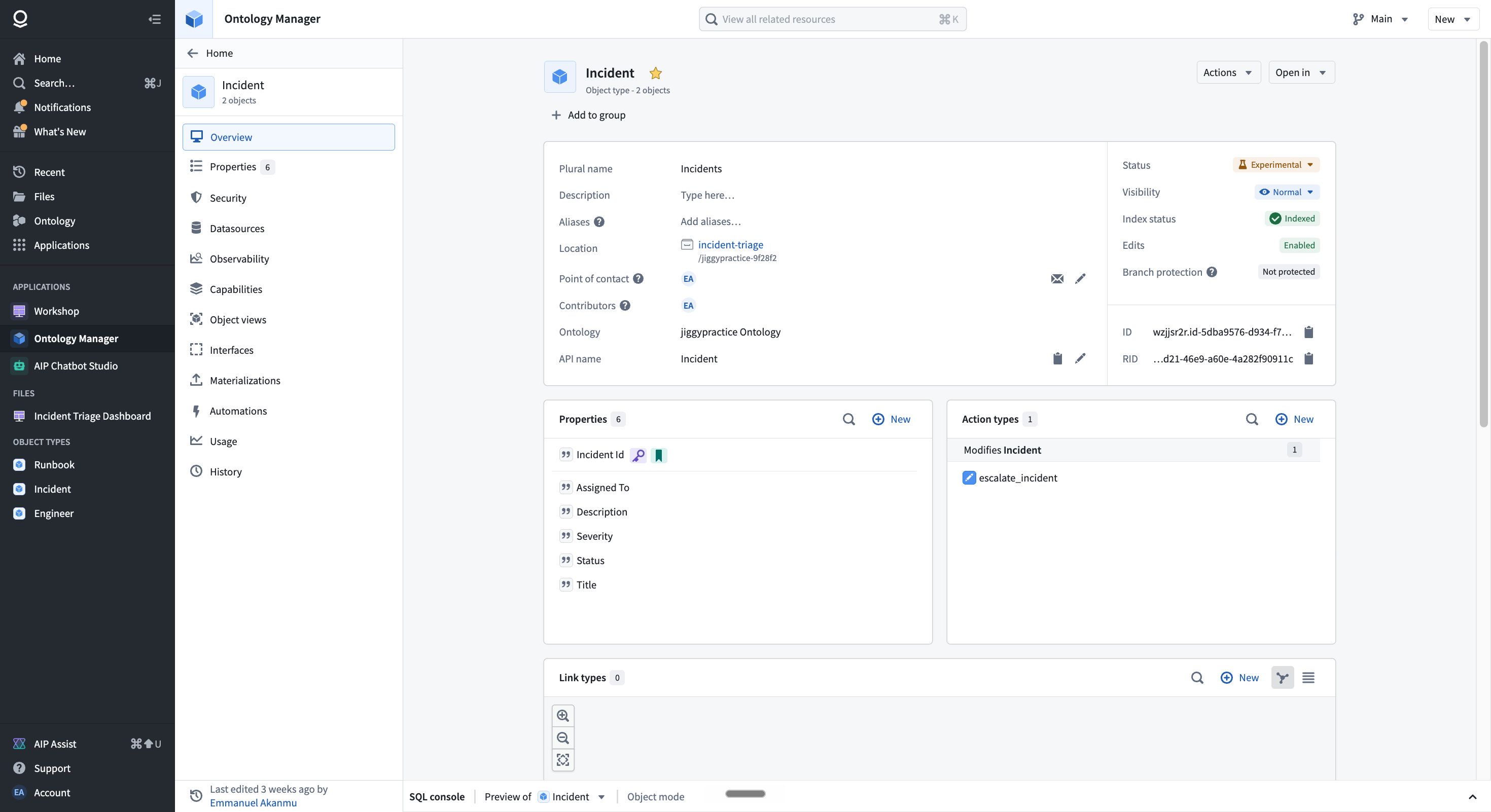
escalate_incident action that modifies it.How it’s built
Data. Three CSVs in the Foundry file system: incidents, runbooks, on-call engineers. Six infrastructure incidents, the runbooks that apply to them, and the engineers with the expertise to handle them.
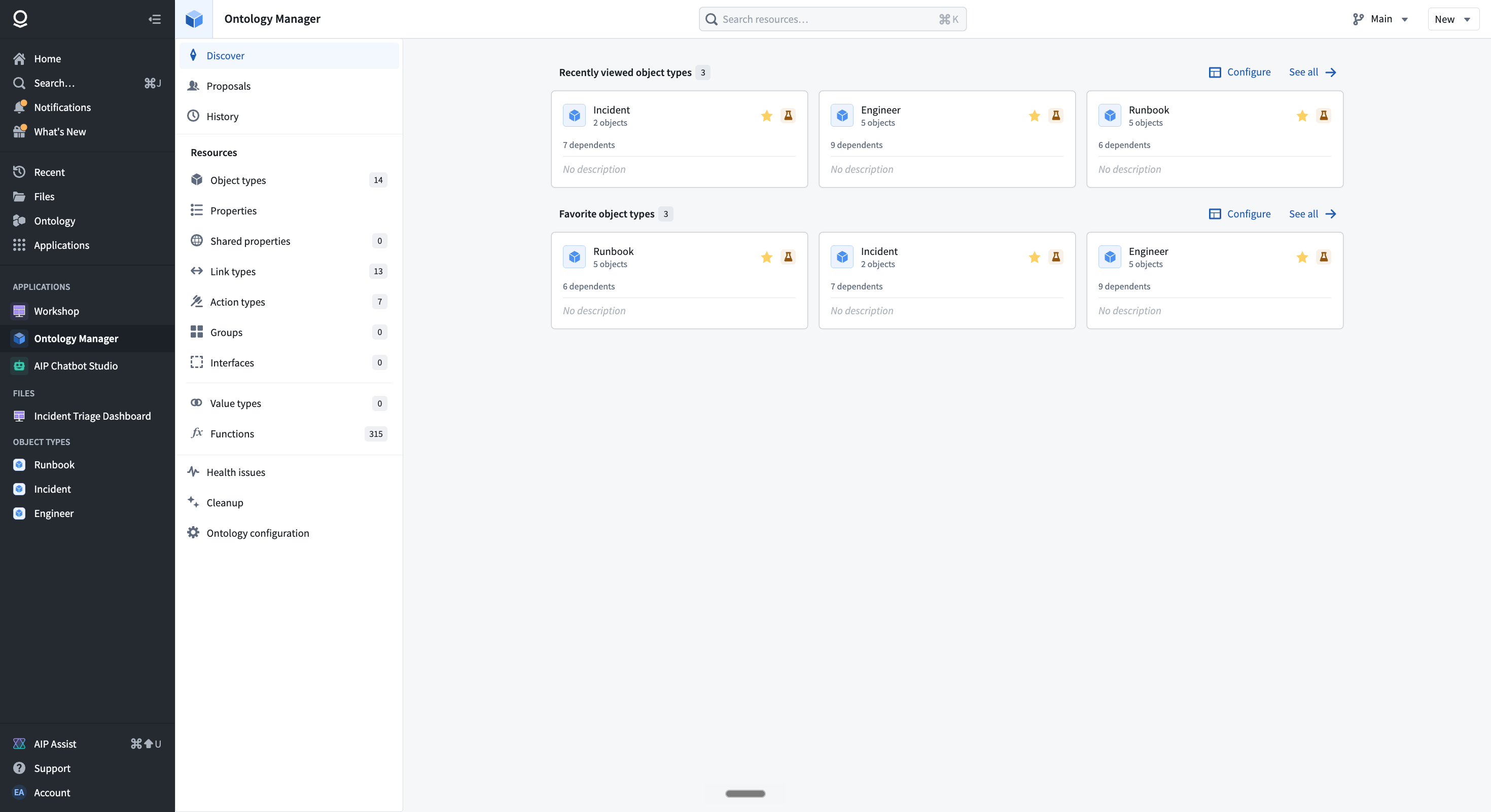
Ontology. Three linked object types in Ontology Manager (Incident, Runbook, Engineer), each with its own primary key, all queryable and semantically searchable by the agent.
Agent. An AIP chatbot with semantic search across all three object types. The retrieval context lets it reason over runbook content, not just the metadata. So when a runbook says “escalate if it persists past 15 minutes,” the agent pulls that rule straight out of the text and applies it.
Action. An escalate_incident action type. It sets status to ESCALATED and
reassigns the incident to the right engineer. The catch: it proposes, it does not
execute. A human approval gate sits in front of it. That gate is the whole
difference between a chatbot and a governed operational workflow.
UI. A published Workshop app with the agent chat, a live incident table that updates the second an action fires, and an approval modal for the governed actions.
The full loop
Someone types “we’re seeing 502 errors on the API gateway.” The agent searches incidents and finds INC-001, the gateway 502 issue, HIGH severity, still open. It pulls the matching runbook, reads the content, and extracts the 15-minute escalation threshold. It finds the on-call engineer whose expertise matches, Marcus Rivera, and proposes the escalation with every parameter already filled in and a reason derived from the runbook logic. Then it stops and waits. The operator reviews it in the approval modal. On approval the ontology writes: status flips to ESCALATED, the incident reassigns, and the Workshop table updates in real time. State change you can watch happen.
When the data’s incomplete
I didn’t only build the happy path. INC-006 is a CRITICAL kernel panic with no runbook that covers it. Ask about it and the agent finds the incident, admits there’s no matching runbook, flags the documentation gap out loud, and still points to the best available on-call engineer. It degrades gracefully instead of pretending it has an answer.
Why it matters
This is the same shape as the MCP documentation agent I shipped at Walmart: an AI layer reasoning over scattered enterprise data and taking governed actions. I rebuilt it on Palantir’s platform with their governance primitives. Data to ontology to agent to actions to UI, the full stack.
The approval gate is the core of it. AI proposes, a human approves, the system executes with a full audit trail. That is the forward-deployed value proposition in one pattern. Empty workspace to published app in about 80 minutes.